Great news!

Too often do I blog about things I want to follow-up and instead I just forget them entirely! But alas! Today at least one of these cases can be closed!!

In March, Brian Kopp filed a lawsuit against Blizzard for blocking his ability to sell his book “The Ultimate World of Warcraft Leveling & Gold Guide” because they felt it violated their intellectual property rights.

And the case has now been settled! Blizzard is now dropping its ‘claims of copyright and trademark infringement’ as long as he keeps his disclaimer of not being an official guide! Isn’t that lovely!!! Way to go Blizzard!!!

For more – The Public Citizen!

Surveillance and invasion of privacy in MMOs

Select Parks has a questionnaire going about surveilance in MMOs. It’s an interesting dilemma. You quickly forget that your every action is being watched and recorded while playing. But I’m wondering if christo might have misunderstood something – if not, I certainly have. In the comments about ‘Game administrators monitoring players’ christo writes:

“The ability of MMO game administrators to monitor and record player
interactions out-strips any type of surveillance occurring within the
real-world. All movements, actions and conversations can be permanently
recorded and archived for later retrieval. Some MMOs use this data to help
suspend player accounts when end user license agreements are broken. For
example, if one player continually harasses another, administrators can sift
through conversation and proximity data to prove an offence has taken
place. Game companies also mine user data to help review and enhance the
game’s structure and playability”

Continue reading

"Girl things" in games

Granted, I really don’t have time to focus on blogging at the moment, so excuse me if I’ve misunderstood this completely! I just….I just couldn’t let this pass by without adding some comments. I’m confused, terrified and well…just a tad insulted, to be honest.

Edward Castronova’s latest Terra Nova post examines one of the ‘theories’ introduced at Ludium 1. Uhm…from what I can gather The Koithuo team proposed a way of looking at ‘the evolutionary theory of human gender differences’ and implementing this as a test into games, using Steen’s ‘girl game modes’ which say “that women will be interested in a) games about rating men’s prowess (The Yenta Game”), choosing men to connect with (“The Marriage Game”), and getting men to stay committed to them (“The Newlywed Game”).”

Now…it seems the crew at A Tale in the Desert have implemented a game in their world to test these theories. Which I completely concur with Castronova when he writes that:

“Regardless of whether you agree with Steen’s theories or not, the exciting thing here is that we get to see them tested, at the level of an entire society. It’s not just a theoretical/political debate any more. We’re getting some information.”

Continue reading

Controversy and drama

Super Columbine Massacre RPG

It’s caused a lot of controversy lately, which I suppose is only natural. It’s a game about the Columbine school shootings of 1999, and you know…it’s not pleasant. This ofcourse has raised havock! Ian Bogost at WaterCoolerGames, who is quite passionate about games with an agenda – wrote an interesting piece a few weeks ago, which has caused people like Brent Bozell, president of the Parents Television Council to call for Bogost’s resignation from Georgia Tech.I suppose that’s what upset me the most really. Personally, I haven’t played the game because it just seemed too uncomfortable, for me – I’m such a wimp, I know.

Mr. Bogost has written yet another brilliant post on the media coverage, which really needs to be read in full – I’ll cut’n’paste the summary here though:

“Most of all, I am deeply worried by this culture of ineffability, a culture that would rather not talk about anything at all for fear that it might make someone uncomfortable. This trend descends from Theodor Adorno’s argument that the holocaust becomes “transformed, with something of the horror removed” when represented in art, thus his famous statement that to write poetry after Auschwitz would be barbaric. These events are considered “ineffable” — unspeakable, unrepresentable. It is a tired sentiment that we must move beyond. Of course topics like 9/11 should make us uncomfortable. Of course Columbine should make us uncomfortable. But that is no excuse to put these issues away in a drawer, waiting for some miraculous solution to spring forth and resolve them for us. If we do so, history is much more likely to forget them. I don’t care if we make videogames, films, novels, poems, sidewalk art, cupcakes, or pelts as a way to interrogate our world. But we must not fear that world.”

Continue reading

Doppelganger Virtual Nightclub

Red Herringreports:

  • The well-funded San Francisco-based company is trying to tie together the trends of online advertising instant messaging, and online gaming. Like many youth-oriented companies in the wake of concerns about safety in public chat rooms and on MySpace, Doppelganger thinks it can walk the line between cool and wholesome”

I don’t know….I just don’t know! There’s supposed to be live DJs and bouncers but there is ‘no punching, hitting, or kissing’ – I can’t help but wonder if that’s just not a tad too boring!

Social places like this need som kind of common denominator – like gaming. The article doesn’t really dwell on what gaming features are available – so I may be wrong here. I very much agree with Mortensen that in order to create new social spaces there has to be a common background and challenges and tasks (she lists more, but I’m sticking with these two for now). I’m not so certain that this can be found by going to a virtual nightclub – but ofcourse if they’re looking at the MySpace tendencies they’re hoping that groups of already established friends will come there to hang out. But this is still different. It seems they’re focusing their attention on the consumer culture and the bodily form of the avatar and things.

  • “In-game advertising is hot, and Doppelganger says it’s ready to pull out all the stops – in a tasteful way, of course…Doppleganger’s immersive advertising will include clothing and media for purchase, both digitally and physically. The ad-coated buildings surrounding its clubs are meant to resemble nighttime hotspots in New York or Tokyo. and the company wants to build out its world, with users decorating their own apartments near the clubs”

So how come this is going to be popular and There never was? And yet…social games like Habbo Hotel are a huge success! Spot the difference?

They’re marketing towards teenagers, but the article fails to mention if it’s restricted just for teenagers. But here’s the thing I think is smart though, “But unlike Linden Lab’s popular Second Life and other massively multiplayer online games, Doppelganger isn’t primarily a full-screen experience. The idea is to slide into the multitasking world of teenagers, with a minimized buddy list screen open at all times”.

This is a type of convergence I can see working (and I’m hating myself now for going to the South Park talk and not Eirik Solheim‘s lecture ‘(?)at the Nordic Media Festival). Just like BBC 1’s festival and their virtual BBC 1 radios in Second Life! I was fortunate enough to experience David Zach‘s talk on Friday – and as he mentioned – the culture today is very obsessed with not letting anyone tell us what we can and cannot do, say or buy – yet most teenager rooms are EXACTLY the same. So I don’t know! Maybe it will catch on, but if it does I’m certain that there needs to be some form of ‘complete individual freedom to do, say and buy’ illusion for these teenagers to think it’s cool! After all, isn’t that some of MySpace‘s allure?

Speaking of My Space…have you noticed the new proposed bill:

"…even if their world doesn’t really exist."

Clickable Culture reports on a lawsuit made against Linden Lab for “a virtual land deal gone sour”. From what I gather, Marc Bragg found some glitch in the system (bug?) of Second Life where he could buy land for under the market value. He decided to invest in this discovery and see if he could make a profit when he proceeded to sell the land for market value.

And from what I gather something suddenly happened that made him loose his Second Life account. According to Bragg, Linden Lab terminated his account “without explanation, without citing any violation of community policy, and have since refused offer a credit or a refund”.

Bragg in a statement says: “These games are like the virtual Wild West, but Linden Lab is still obligated to honor real-world contract law and consumer law, even if their world doesn’t really exist.”

Of course he’s right! Second Life has a potent market with US dollars and since they’ve issued Intellectual Property rights to their citizens – they really do have to think about real life contract and consumer law. Second Life very much exists then, if you ask me. But by what laws should they adhere to? Don’t get me wrong, I love what Second Life has done! But with it comes some democratic responsibility and not dictatorial rule. I’m no lawyer, so I’m not sure – and to be honest, lawsuits like this kinda scare me for what’s going happen in the future. I, for one, don’t want too much reality in virtual worlds although it is exciting to see it evolving, it’s like a whole new society being born – and that is fun!

I find it really suprising if Linden Lab truely has behaved in this manner. They must have been prepared for this happening somehow, haven’t they? And I’m sure they’re within their rights of punishing those who take advantages of bugs for profit (after all, we’re not talking about a game here, we’re talking about reality) – but to just cut him off with no reason, no explanation and furthermore no dialogue! I’m sure they could have worked something out, somehow and learned from this ‘glitch’! So…I’m not sure if this is really the way it all went down – I’m looking forward to hearing Linden Lab’s response!
Public Diplomacy Through Games

The University of Southern California has come up with the novel idea of hosting a competition to create a game promoting public diplomacy. I’ve been eagerly awaiting the results for months now!

“The USC Center on Public Diplomacy is looking for people to showcase their talent with a bit of world class game-making. The challenge to the game mod community, and current and aspiring game designers is as follows: design a prototype or modify a game incorporating the fundamental characteristics of public diplomacy”

The finalists’ presenations are now available and the winner is to be announced today.

Looking at these, I was searching for something creative and fun. As much as I adore and admire simulations such as Peacemaker – I was hoping something less ‘obvious’ would make the finalist list as well. I’ve often thought that the trick to learning in computer games is to hide the ‘message’ behind humor and absurdity. For a game to be truely successful in teaching something like the promotion of diplomacy, I feel it has to lure those who just want to go and have a great gaming time as well. I know of very few who play to learn something and having played my fair share of dreary simulation games for the jobs from my past (I’ll have to tell you about those some day! ) they usually don’t work (at least I can’t remember what I was supposed to learn).

I truely love the idea behind Hydro Hijinks, it actually made me think about Myst and the game of consequence.

The others are brilliant as well! Ambitious but lovely! I would however, love to see more fun and absurdity!

Anyways it’s a great initiative and a big ‘yay!’ to Second Life for making them all possible!

Virtual money available from RL cash machines


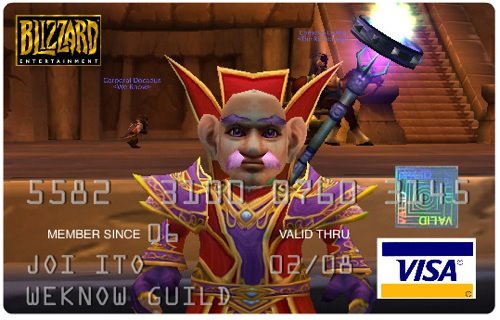
Well there we go! The transition has been made! Project Entropia has finally released a cash card that “allows people to access their virtually acquired PEDs (Project Entroipia Dollars) and convert them into real money at any cash machine in the world”!
It seems only natural that Project Entropia would be the first to do this, as the description goes: “The Entropia Universe is not a game. The Entropia Universe is for real. Real people, real activities and a Real Cash Economy in a massive online universe” – it’s reeked capitalist hunger ever since we started hearing about the $100,000 space station.

I’m really hoping that no true MMORPGs are gonna end up doing this! Seriously, I’m more and more against RMT and rather protect the magic circle of the game! Being the financially retarded person, that I am – I would never get anywhere in the world that I love to play in and escape to! I would end up being on the bottom level all the time! And I would have to make these gruesome decisions like should I liquidate (thats what they say on all the Wall Street films at least) my virtual posessions so that I can go be sociable with RL friends but be completely broke in-game or just sit at home and play and forget RL entirely? I mean…I would hate to be confronted with those decisions!

I do however, believe that MMORPG players should be given some symbolic license of authorship somehow – but that’s another blog post all together.

Picture taken from the Make: article: The Future of Credit Cards – Earning virtual currency for spending in the real world & other world bridging.

Sony Station Exchange and GMs responsabilities

So, yeah! I’m still trying to write about intellectual property rights within MMORPGs. I’ve pretty much come to the conclusion that reputation is a commodity in MMORPGs, both for the game developers and the gamers themselves, and I’m wondering if it is this reputation that is or should be protected within intellectual property rights! Firstly I’ve used Eriksson and Grill’s DiGRA 2005 paper “Who owns my avatar? – Rights in virtual property” for inspiration to illustrate the different interests game developers and gamers have in intellectual property rights. From their excellent paper:

“Two main interests are discernible in connection to the game producers:

  1. Subscription interest – virtual trade may decrease a game producer’s income from subscriptions. If new players buy advanced characters for real money they won’t have to spend time in the game (which they consequently would have to pay for) advancing their own avatars. The subscription interest is also affected by the fact that the game producer may get a bad reputation by letting people with more money than time buy themselves into the game, resulting in gamers leaving the virtual world
  2. Control interest – developers have an interest in remaining in control over their creation. In part, this may be a purely creative interest, quite separable from the subscription interest. Often, producers wish that their virtual world should remain a game only. The recognition of ownership rights in the virtual world of their game may thus conflict with their wish to control that world. Producers therefore try to establish norms implying that trade in virtual property with real money should not exist”