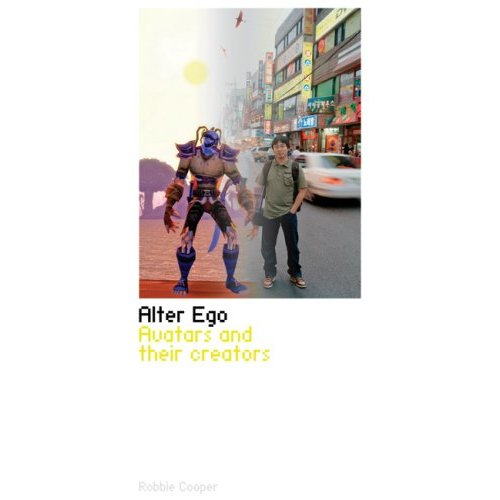
Robbie Cooper’s book Alter Ego: Avatars and their Creators is out in May! I’ve been waiting for this a loooooooooooong time now! Can’t wait! It’s such a wonderful project!!
Category Archives: Avatar
Columbine game is all about art!

It’s funny how certain tragic events can spawn new luscious things!
There’s been a whole lotta uproar these past few weeks because Super Columbine Massacre RPG was pulled as a finalist from the Slamdance Guerilla Gamemaker Competition.
Personally, I can’t believe they waited for it to get so far only to pull it off the list – which makes me rather suspicious. They write that:
“There are always legal checks and balances with any Slamdance program. Specifically with the subject matter of Super Columbine Massacre Role Playing Game Slamdance does not have the resources to defend any drawn out civil action that our legal council has stated can easily arise from publicly showing it.”
Man! Capitalist society can be such a ruthless freedom-of-speech stomping evil dictatorship!
Then, other game developers start pulling their games from the festival in an act of solidarity. TGC (thatgamecompany) explained it very nicely:
“As game designers, each project we have done so far, and plan on doing in the future, aims at showing games as a serious and expressive medium. We cannot help but wonder, if SCMRPG were a film, if the reaction by the Slamdance organizers would have been the same. Removing it from the festival is discouraging, because it implies that games are still not to be taken seriously, that games are only for mindless fun. If we are trying to work against this stigma as artists, then we also have to fight against this stigma as entrants in the festival as well.”
So this incident has really triggered an inspirational discussion about games as art! Which I think is really exciting! And my heart pounded even more when I read Clive Thompson‘s excellent piece, ‘I,Columbine’ in Wired this week! I don’t think I’m exaggerating by saying it’s the best artistic critical analysis of a game I have ever read!
You’re constantly reminded of how creepily unbalanced Harris and Klebold were. One minute they’re tossing off nihilistic riffs: “When I’m in my human form, knowing I’m going to die, everything has a touch of triviality to it,” Klebold muses. The next minute they’re quoting Shakespeare: “Good wombs hath borne bad sons.
I’m having a hard time pulling out quotes because it’s all so relevant and good – but I’ll paste this one in just in case you don’t read the whole thing – but you really should! It’s a beautiful beginning of art criticism in games!
“It uses the language of games as a way to think about the massacre. Ledonne, like all creators of “serious games”, uses gameplay as a rhetorical technique.”
Gameplay as rhetorical technique! I love it!!!
It’s tragic that Slamdance felt they had to pull it from the competition – but I’m loving the discussions that have spawned from it!
MMORPG professionals
Raph Koster writes about a new group that calls themselves “The Virtual Citizenship Association”. It’s a new group advocating virtual citizen ehm ‘rights’. In his blogpost he points out the relevant problems with their social contract – which I completely agree with – so I’m not going to bother repeating it all in my own words here – you should just read it – I can’t do his words justice here!
But entering the site – I was quite intrigued by how they define themselves:
“We’re a group of MMORPG professionals, people who enjoy playing in online universes in general and people who advocate the use of Free Software.”
I find that interesting. When I think of ‘MMORPG proffesionals’ I think of game operators and designers – not players, but it’s a relevant point! Why shouldn’t players be labeled as MMORPG professionals? I kinda like it – it tickled me!
As for what they’re advocating, I agree with Koster when he writes:
“I’d prefer any such social contract to focus more on how operators have to treat players, than on forcing particular business models on operators.”
Too right!
And in case you don’t have the time to read the comments, I have to paste glorious Mr. Bartle’s comment – where would this industry be without his precious sense of humor?
“Why is it that these “players’ rights” advocates always target the virtual world developers and never the people who run guilds?
Richard
PS: Wouldn’t it be amusing if a virtual world developer banned membership of such organisations under its EULA?”
State of Play – New York Law School
So they’ve had a State of Play conference in New York and Mark Wallace does a wonderful job of summing up the whole thing – bless him! Looks like they’ve really been critical of themselves and looking to see what could be done in future research – which I think is good!
One thing that surprised me however was Jesper Juul’s post on the discussion of ‘games have rules’. I’ve accepted that ages ago, and I really don’t understand what the problem is in acknowledging that games have rules and most importantly NEED rules – but apparently, they still can’t agree on that. Juul breaks the discussion down to two positions – pro-rules vs. anti-rules.
“Pro-rules people generally make pragmatic descriptions of the gameplaying activity, and anti-rules people commonly apply a general poststructuralist skapticism towards descriptions of structure.”
I’m baffled that this is still disagreed upon. In my thesis (which I’d love to write all over again) I broke everything down to two issues – gameplay and societal -> rules and identity. Just because some players choose to defy some of these rules doesn’t mean that they’re not complying with them. Rather acknowledging them to then defy them. The gameplay rules are what makes the world a game – and we mustn’t forget that worlds like, Second Life are NOT games – so we should stop using them as examples. The societal rules are something that is considered by your gameplay method and social communication. Um – maybe I’m not ready to talk about this yet.
Making sense of virtual property research
I just realized that I haven’t blogged anything about VERN – Virtual Economy Research Network, here! Well…I’m just gonna point you in the direction – to start you off, there’s an interesting post/essay on “Making sense of virtual property research” – I would say it’s a must for anyone wanting to look into such matters! I felt it was very helpful!
Shooter!

How cool is this?!!! Shooter is an art project based on a video and pictures of players at private LAN parties organised by the artists Beate Geissler and Oliver Sann. Vigourating!!!
The abstract:
The two-part work “Shooter” by the artist duo Geissler and Sann consists of a video and photo documentation of LAN parties organised by the artists in their studio over a period of a year and a half. Both the video sequences and the photo documentations show the players front-on against a neutral background from a constant camera angle.
The video, on show at the exhibition, observes the players during a fight scene, i.e. while they are killing or getting killed in the virtual world of the network while sitting in the same room as their adversaries. The video shows moments of intense concentration of a temporary tension characterised by inner drama. According to the artists, “The viewer … witnesses a life-and-death game with no consequences”.
“Shooter” presents a test set-up with which to analyse the human relation to real and virtual spaces and the associated gestures and facial expressions. At the same time, the artists question the function of the real body and the game of identities with reference to New Technologies.
The specially installed web site features a documentation and a guest book in which the portrayed players can leave their comments.
(Silke Albrecht)
Found at Game Scenes (which I don’t have time to investigate further at the moment, but definitely on top of my ‘to do’ list!)
South Korean gaming culture
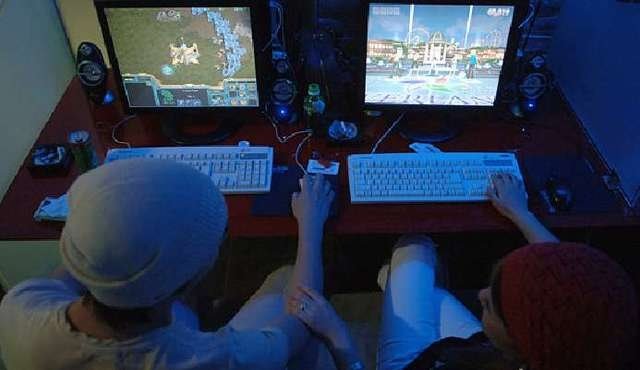
The New York Times has an interesting piece on the gaming culture in South Korea. It’s so well written and balanced that it just deserves a mention here!
Seth Schiesel really makes an effort in understanding why pc gaming is such a vital part of Korean culture. Several interesting points, really.
Lee Chung Gi, owner of the Intercool bang, said: “It’s impossible for students in any country to study all the time, so they are looking for interesting things to do together. In America they have lots of fields and grass and outdoor space. They have lots of room to play soccer and baseball and other sports. We don’t have that here. Here, there are very few places for young people to go and very little for them to do, so they found PC games, and it’s their way to spend time together and relax.”
Which reminded me of Henry Jenkins’ “Complete Freedom of Movement”.
He also mentions the Korean student work culture and how parents are encouraging their kids to play to ease the stress of expectations. But he doesn’t deny that there is a problem with gaming addiction as well.
Great lazy Sunday reading and there’s even a multimedia presentation! And you just have to love the fact that they have loveseats in PcBangs, like in this picture! I’ve got to take a tour of Internet Cafés here in Bergen to see if anything similar exists here!
Brought to my attention by fascinating blogger Alice in Wonderland.
What I’ve learned – Part 1
I’m wrapping up my typology of TSO players and intellectual property rights chapters this weekend and I’m getting kind of sentimental and sad about ending a chapter in my life also – and all my…ehm…work being visible on paper. I could have easily finished this sucker a year ago, but then I would have missed out on a few thoughts and new insights. But I suppose that also has contributed to my low self esteem and the constant second guessing of my thoughts, memories, sentences, conclusions, understandings, sanity and intelligence. So I’m not recomending the extra year, far from it, but I’m just saying that I’m glad I took it. I’ve had such a great time, learning so incredibly much – both relevant and irrelevant.
One thing that I absolutely adore and despise about Media Studies is that it encompasses so incredibly much! Back in my bachelor days I never quite got into the spirit of ‘reading’ film – I mean, sure! I loved reaching for hidden meanings and mis-en-scene and – well, to be honest I’m getting bored just writing about it now, so maybe ‘love’ is too strong a word here. Two semesters of film classes was quite enough for me. Anyways…I was lucky and privileged to have Tiziana Terranova introduce me to…ehm…I think we called it Cyberculture, back then (1997-2000) – which blew my mind and woke my desire to learn more! I remember becoming a huge Baudrillard and Foucault fan and discussing hyperreality with passion at the local pub. Ooooh! I’m about to give you my life story here aren’t I? I suppose my point is that I come from a Media Studies background, a part of the Cultural Studies movement (?). On paper I can supposedly ‘read’ film, pictures, commercials and understand media politics (hahahahaha!) and well at least discuss the issues of identity in media and semiotics.
Girl gamers
I had the priveledge of meeting a new enthusiastic Media Masters student a few weeks ago looking to write something about gaming. Yay!!!!! From what I understand, she had grown up being a bit of a gamer and didn’t quite understand why other girls weren’t as well. We ended up having a conversation about the phenomenon “female closet gamers”. You know the type…the girls who’ll gladly dismiss games as a waste of time and a nerdy thing – but secretly they have a nintendo at home! Anyways…it seems like this is the topic she wants to pursue – and I just thought I’d throw it out there and see if anyone knows of someone doing something of the same research?
I guess she’s gonna have to divide between casual and ‘serious’ (although I hate that word) gamers. And I know I’ve got some articles hidden away here somewhere in my del.icio.us. (it’s taken me SUCH a long time to find a tagging system that actually works for me – some stuff just gets lost). I’m wondering how best to tackle such a question.
I’ve already mentioned Hilde Corneliussen (also…didn’t a student from good ol’ HI department hand in a thesis about this recently?)and Torill Mortensen. Also Henry Jenkins ofcourse.
The student is a blogger – AND WE LOVE BLOGGERS!!!!!!!!!!!!!!!!!!! So bless her!!!
She’s written a post where she ponders about tackling the Nintendo Wii and how they’re trying to bring in the casual gamers and women (in Norwegian) and I was thinking it might be interesting to analyse how the Xbox360, PS3 and Wii differ in their advertising.
But I thing she’s more of an audience kind of gal! I’m wondering if the answer lies in finding the hardcore female gamers who are out of the closet, interview them to see if they think it’s a big deal or not? And I think maybe she should stay away from MMORPGs – because they sometimes seem to be an exception. And I think it would be cool to look at 20 year olds and above.
Breakfast with Nick Yee
I spent this morning curled up on my sofa with breakfast and coffee and watched Nick Yee’s presentation at PARC – “The Blurring Boundaries of Play: Labor, Genocide, and Addiction”. Every now and then it’s good to have a ‘step back and see the whole picture’ presentation – I thoroughly enjoyed it! Ofcourse Mr. Yee’s fabulous work on why people play is represented, but he also covers the terrain of addiction, gold farming and ‘the new golf’!
Definitely a good start for anyone wanting to look into MMORPGs and what they’re all about. Any new students wondering what to write about? Watch, watch, watch!!! To me, it was a joyous breakfast, but now…I’m gonna be late for a lecture!
 Remember What The Dormouse Said