South Korean gaming culture


The New York Times has an interesting piece on the gaming culture in South Korea. It’s so well written and balanced that it just deserves a mention here!

Seth Schiesel
really makes an effort in understanding why pc gaming is such a vital part of Korean culture. Several interesting points, really.

Lee Chung Gi, owner of the Intercool bang, said: “It’s impossible for students in any country to study all the time, so they are looking for interesting things to do together. In America they have lots of fields and grass and outdoor space. They have lots of room to play soccer and baseball and other sports. We don’t have that here. Here, there are very few places for young people to go and very little for them to do, so they found PC games, and it’s their way to spend time together and relax.”

Which reminded me of Henry Jenkins’ “Complete Freedom of Movement”.

He also mentions the Korean student work culture and how parents are encouraging their kids to play to ease the stress of expectations. But he doesn’t deny that there is a problem with gaming addiction as well.

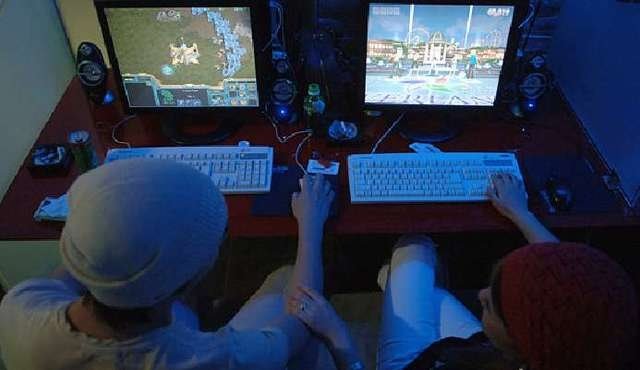
Great lazy Sunday reading and there’s even a multimedia presentation! And you just have to love the fact that they have loveseats in PcBangs, like in this picture! I’ve got to take a tour of Internet Cafés here in Bergen to see if anything similar exists here!

Brought to my attention by fascinating blogger Alice in Wonderland.

What I’ve learned – Part 1

I’m wrapping up my typology of TSO players and intellectual property rights chapters this weekend and I’m getting kind of sentimental and sad about ending a chapter in my life also – and all my…ehm…work being visible on paper. I could have easily finished this sucker a year ago, but then I would have missed out on a few thoughts and new insights. But I suppose that also has contributed to my low self esteem and the constant second guessing of my thoughts, memories, sentences, conclusions, understandings, sanity and intelligence. So I’m not recomending the extra year, far from it, but I’m just saying that I’m glad I took it. I’ve had such a great time, learning so incredibly much – both relevant and irrelevant.

One thing that I absolutely adore and despise about Media Studies is that it encompasses so incredibly much! Back in my bachelor days I never quite got into the spirit of ‘reading’ film – I mean, sure! I loved reaching for hidden meanings and mis-en-scene and – well, to be honest I’m getting bored just writing about it now, so maybe ‘love’ is too strong a word here. Two semesters of film classes was quite enough for me. Anyways…I was lucky and privileged to have Tiziana Terranova introduce me to…ehm…I think we called it Cyberculture, back then (1997-2000) – which blew my mind and woke my desire to learn more! I remember becoming a huge Baudrillard and Foucault fan and discussing hyperreality with passion at the local pub. Ooooh! I’m about to give you my life story here aren’t I? I suppose my point is that I come from a Media Studies background, a part of the Cultural Studies movement (?). On paper I can supposedly ‘read’ film, pictures, commercials and understand media politics (hahahahaha!) and well at least discuss the issues of identity in media and semiotics.

Continue reading

Velvet-Strike

This is new to me…and oh…how beautiful!!! I’m truely touched!

Velvet-Strike is a collection of spray paints to use as graffiti on the walls, ceiling, and floor of the popular network shooter terrorism game “Counter-Strike”. Velvet-Strike was conceptualized during the beginning of Bush’s “War on Terrorism.” We invite others to submit their own “spray-paints” relating to this theme.”

It’s just…beautiful! Anti war graffiti in such a ‘reality-like’ war game? Amazing! And as they state:

“You are for or against us, you are with us, “the one”, or you are with the enemy is the underlying logic of the West, as I understood a talk by Marina Grzinic at an international cyberfeminist conference in Germany in December 2001. (Pre-axis of evil.) Although computer games replicate this binary competitive logic maybe there is something ultimately subversive in the knowledge that it is only a game, that at any moment you may switch sides with the “other”, you may play the terrorist side in Counter-Strike.”

and

“Reality is up for grabs. The real needs to be remade by us.”

I’m such a sucker for movements like this!!! Gives me so much hope! And I’m going to stop now before I get all sappy!!

Synthetic World News


Castronova’s posse at the Indiana University have started a blog called Synthetic World News! I don’t know why this has passed by me! Anyways…these are the folks behind Ludium (I’m still dumbfounded by their innovative creativity on research) so most likely interesting things will be revealed here!
First up is the Kuurian Expedition and they’re having a meeting at the Hall of Explorers, Ironforge, Silver Hand at 10 pm EST August 2, 2006. From what I gather it is a bunch of experienced researchers/players showing new people what synthetic worlds are all about and how we can learn and build from them. But I’m sure this sounds interesting to all you other WoW freaks as well!
I’m staying away from it all and trying to wrap things up! Although I’m suffering from some annoying syndrom that makes me fall asleep each time I open my thesis!! I will prevail though!! I shall conquer this beast of mumbo jumbo sadistic slime!!

Frasca

This whole narratology vs ludology discussion is quite…well…ARGH! Just frustrating, I guess – and ofcourse this comes from the fact that we’re still trying to figure out the language of games.
So I had a glance at my huge ‘to read’ pile the other day, upset because I keep maneuvering myself into tight suffocating corners that I can’t spread my wings and fly away from. But I guess that’s what writing a thesis is all about ey? Narrowing things down to the bare essentials and constantly contradicting oneself?
Anyways! I pulled out some Gonzalo Frasca, which I had put aside because I naively thought I could escape the whole narratology vs ludology debate! He uses a Markku Eskelinen quote which I LOVE!

“As Markku Eskelinen argues, “outside academic theory people are usually
excellent at making distinctions between narrative, drama, and games. If I
throw a ball at you I don’t expect you to drop it and wait until it starts
telling stories””

Don’t you just love that?! What a great way to mock the debate! Anyways…the article (or is it an introduction chapter?) can pretty much be summed up by:

  • representation vs. simulation
  • Aarseth’s cybernetic systems
  • simulation semiotics or “simitiocs” (what a lovely new word!)
  • “Simulations can express messages in ways that narrative simply cannot” (how bold!!!)
  • A discussion on Caillois’ definitions of ‘play’ and ‘game’; piadia and ludus
  • 3 act rule (which I’ll write more about in next post)
  • 3 different ideological levels in simulations
  • A typology of simulation rules

You’ll be reading a bit more about this later on today or tomorrow! I’m at work right now and I don’t have my Jesper Juul or Espen Aarseth notes available!

Hmmm….so why did I even bother writing this post? Well first off…you have to admit that quote is amusing, but probably because I’m in the middle of writing a job application to a really cool job, and didn’t want the first post they saw to be my emotional worship of the Sultan’s Elephant! He he! The dilemma’s of linking to your blog everywhere and at the same time trying to sell yourself as a sane desirable person!!

Joi Ito on…well…’the state of the metaverse union’?


So I specifically turned my back on an absolutely glorious sunny day today, to work on a job application and finish up some thesis thoughts I had this morning (burnt the midnight oil) – but first things first – feeds need to be skimmed through!
Rather annoyingly erikso.com had a truely informative and extremely interesting post, loads of stuff I’ve just automatically loaded on to my iPod for the walk home tonight – but I ended up watching the whole of this charming videoblog by Loïc Le Meur (loads of other interesting things on his blog – I became a subscriber instantly), where he talks to Joi Ito about – well…everything important!!!! Joi Ito gives the best description of what playing World of Warcraft is about, EVER!!!!! What we can learn from MMORPGs and how we can incorporate several models into the business world. Ofcourse gold farming comes up -and Ito brings up an interesting observation that the Chinese had a hard time understanding what we have against gold farmers, according to them it’s a given that people with money should be able to pay their way to the top in games. Really ironic – that we in the capitalist world believe every MMORPG gamer should be equal, while the Socialist Chinese are all for money buying gaming fame and fortune! Amusing. Then they have a great talk about videos, music and copyright – and ofcourse the Creative Commons – and what all this sharing business is all about. It was really interesting!!! And it was so relaxed listening to them just have a conversation! Very inspiring! Definitely worth skipping a film or tv program to watch! But now – must work!!

Picture stolen from erikso.com! Thanks!!

When technology governs

Mark Wallace had a very honest and reflective post in his blog yesterday about ‘the issue of trademark, copyright and intellectual property rights in Second Life’. There seems to be a lot of trust in Linden Lab’s technology to take care of these rights – but that technology can only govern in its space, Second Life. If someone were to copy these virtual objects into another program – what happens to these issues? If then the object comes back into Second Life but modified from another program? And…well…what about when some of the virtual objects become real, without the original creator’s consent? And…oh I’m on a roll now – with virtual worlds such as Second Life, where citizens are making real money from real businesses – well, Linden Lab can’t protect the intellectual property rights of this, can they…would they?
It seems the IP rights issued for creators in Second Life are governed by technology – the ability to protect objects from being copied technolgically. But ideas and creativity go so far beyond technological restrictions, do they not?
Mr. Wallace feels that laws of the physical world should apply to the metaverse as well. And what I think is so funny in these discussions is the assumption that we’re trying to protect the rights of the little man from being stolen from the big corporational man! Or is it just me? These programs were designed to help creators – to create, to be imaginative, to be free – when we start protecting things with an iron fist of the law (real world) and screaming out “You can’t touch this, this is mine ALL MINE!” (wow – it just dawned on me why MC Hammer’s “U Can’t Touch This” is so popular now days) – it tends to put a damper on creativity and freedom to express oneself. If there’s absolutely anything this whole Web 2.0 movement has taught me is that you can actually trust people to create, be thoughtful and respectful at the same time. Give them the trust and they’ll give you a lovely gift economy.
I guess I’m wondering, what’s stopping the Creative Commons being involved in Second Life? I’m actually asking here! Is there really a need to go as far as the courts to deal with this issue? And does someone really have to be sued in ‘small claims court’ in order for people’s creativity to be protected as their own?
I’m very wary of the advocation to get real world courts involved in issues concerning the metaverse, but I find Second Life a difficult issue. It’s gone so far beyond any definition of a game and the protection of ‘the magic circle’, so I really can’t say if I agree with Mr. Wallace’s post or not, I just thought I’d point it out as an interesting read! But I will concur that I don’t think we can trust technology to govern such worlds! As he so cleverly puts it:

“If the focus remains on technology as enforcer of the law, then it will eventually be (as Lawrence Lessig has pointed out) the technologists who are writing the laws. Now, I’m all for technologists, don’t get me wrong. But we didn’t elect them as legislators, did we?”

"Girl things" in games

Granted, I really don’t have time to focus on blogging at the moment, so excuse me if I’ve misunderstood this completely! I just….I just couldn’t let this pass by without adding some comments. I’m confused, terrified and well…just a tad insulted, to be honest.

Edward Castronova’s latest Terra Nova post examines one of the ‘theories’ introduced at Ludium 1. Uhm…from what I can gather The Koithuo team proposed a way of looking at ‘the evolutionary theory of human gender differences’ and implementing this as a test into games, using Steen’s ‘girl game modes’ which say “that women will be interested in a) games about rating men’s prowess (The Yenta Game”), choosing men to connect with (“The Marriage Game”), and getting men to stay committed to them (“The Newlywed Game”).”

Now…it seems the crew at A Tale in the Desert have implemented a game in their world to test these theories. Which I completely concur with Castronova when he writes that:

“Regardless of whether you agree with Steen’s theories or not, the exciting thing here is that we get to see them tested, at the level of an entire society. It’s not just a theoretical/political debate any more. We’re getting some information.”

Continue reading